
Democracy is Declining Globally and in the US, and the Year Ahead Could Prove Decisive
New reports show that the vaunted "Third Wave" of democracy has now been mostly erased and American democracy is on the rocks. 2026 could determine whether there is a turnaround.

Last week, two major global democracy watchdogs released their annual reports on the state of democracy in countries around the world. Their assessments are grim. According to the V-Dem Institute at the University of Gothenburg in Sweden, democracy for the average person in the world has returned to a level last seen 1978. It concluded that the gains in global democracy since the mid-1970s “are almost eradicated.” The United States also lost its status as a liberal democracy, retreating to a lower-tier “electoral democracy” as it was in the 1950s and early 1960s before the Civil Rights movement.
The democracy report from Freedom House, ominously titled “The Growing Shadow of Autocracy,” wasn’t more cheery. It registers 20 years of consistent declines in overall democracy around the world. Among countries it classifies as “free”, the US has registered one of the steepest declines over the last two decades.
These reports together indicate major headwinds for democracy. Political regimes overall tend to move slowly. Global trends in a given direction can be reversed, but that doesn’t occur quickly or completely. The coming year, however, will provide important signals of whether the world is sinking deeper into democratic recession or if it may start to emerge.
Global Democracy Trends
Twenty-five years ago, the outlook for democracy around the world was quite positive. Authoritarian regimes around the world were falling and democracy was advancing and deepening. After some period of debate among researchers in the 2010s and early 2020s over whether the world was entering a period of democratic recession, recent trends clearly indicate that democracy is ebbing. The world’s autocracies now outnumber its democracies (92 to 87 according to the V-Dem report) and nearly three-quarters of the world’s population live in autocracies. The map of liberal democracy below, which ranges from 0 (full autocracy) to 1 (robust liberal democracy) shows enormous swathes of the globe blanketed in authoritarianism.
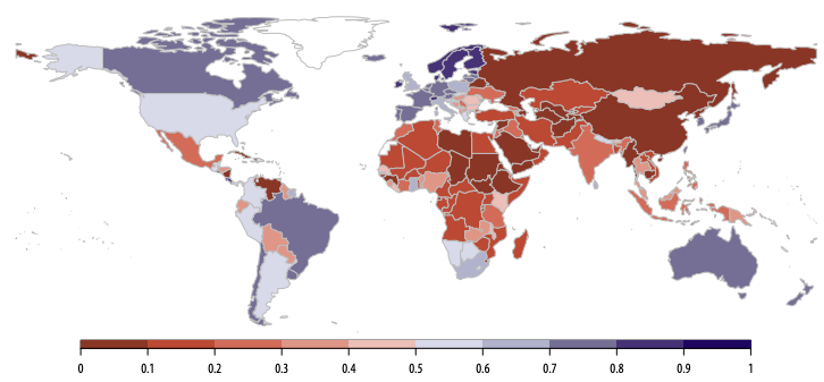
By V-Dem’s assessment, four of the five most populous countries in the world are now autocracies (India, China, Indonesia, and Pakistan). The fifth – the US – has been downgraded from a liberal democracy to an “electoral democracy” due to political developments during President Trump’s first year back in office. (Electoral democracies enjoy free and fair elections and universal suffrage, whereas liberal democracy adds a strong rule of law and robust judicial and legislative checks on executive authority on top of electoral democracy.) Their bottom-line takeaway from this is bleak: “The ‘center of gravity’ for human experience and global governance has shifted heavily toward authoritarianism.”
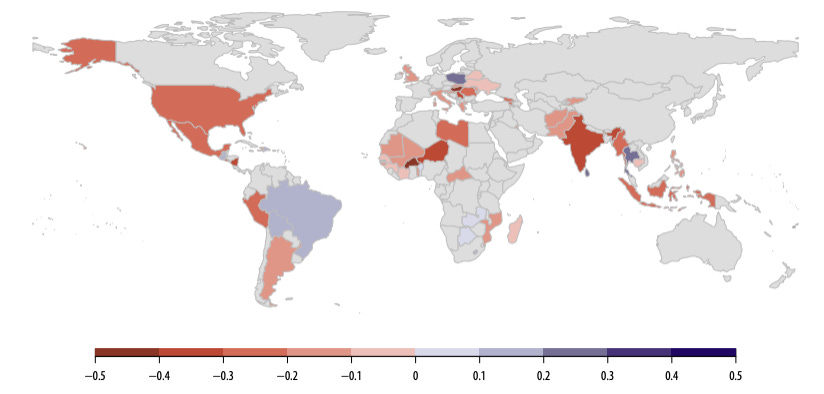
V-Dem counts a total of 44 countries in active episodes of democratic decline, while only 12 are becoming more democratic. Countries where democracy is weakening or has collapsed are spread across the globe, with some clusters in the Americas, West Africa, Eastern Europe, and South Asia (see map). The report points out 3 trends that are combining: democratic erosion in some traditionally stable democracies (like the United States), democratic reversals or breakdowns in countries that transitioned to democracy sometime in the last 50 years (like Mexico and Indonesia), and the deepening of authoritarianism in already authoritarian states (like Myanmar and El Salvador).
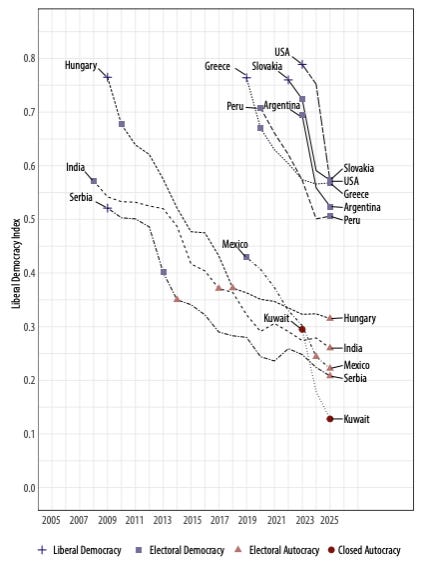
Some of the most rapid and precipitous declines in democracy are also taking place across the world. Democracy in the US, Argentina, Greece, Hungary, India, and Mexico has taken a rapid nosedive (see figure below). In countries like India, Mexico, and Hungary, those declines have snuffed out young democracies. At the heart of this transformation is the undermining of freedom of expression, media censorship, and repression of civil society. Although election quality has declined in some of these democracies, that is not always the case – indicating that the mere fact of holding elections is not enough to sustain democracy.
Freedom House similarly observes that numerous rights and civil liberties have diminished over the last two decades, with the heaviest blows to media freedom, freedom of personal expression, and due process. In many cases, the erosion of these democratic freedoms has come at the hands of elected leaders.
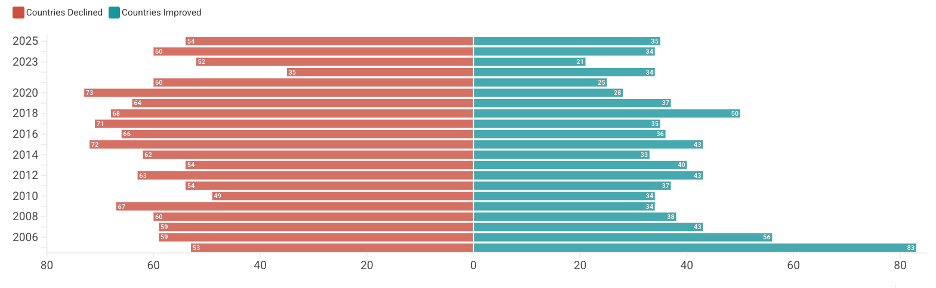
The Freedom House report identifies 54 countries that saw political rights and civil liberties decline last year, while only 35 countries improved on those dimensions. (Freedom House’s methods differ from V-Dem’s methods when it comes to classifying democracy and changes in degrees of democracy; it consequently tends to record a larger number of small annual variations in democracy scores than V-Dem.) The tendency of democratic decline outrunning democratic gains is now 20 years long and running (see chart below). According to Freedom House, 45% of countries are free and democratic, but now 30% are unfree and 25% are partly free.
Democratic Erosion in the US
The V-Dem and Freedom House reports agree that the United States is a steeply declining democracy. “The speed with which American democracy is currently dismantled is unprecedented in modern history,” V-Dem concludes. US democracy scores since the re-election of Donald Trump in 2024 demonstrate a rapid plunge, far faster than other countries that are suffering democratic declines.
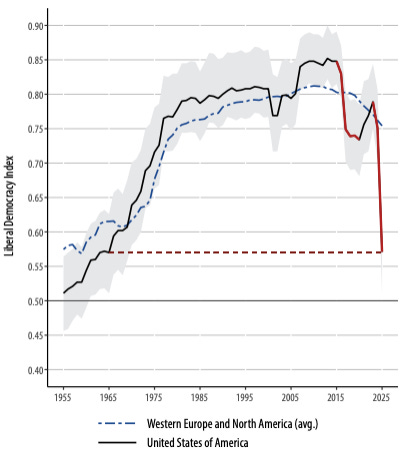
The decline, as readers of this newsletter already know, is due to a “rapid and aggressive concentration of powers in the presidency.” That high-level fact rests atop a mountain of transgressions against democratic rules and norms: attacks on the press, academia, private firms, civil liberties, and dissenting voices, executive overreach that undermines the rule of law, and a steep drop in legislative constraints on Trump by the Republican-controlled Congress.
Notwithstanding those grave developments, V-Dem points to the Supreme Court as a remaining check on the Trump administration’s most autocratic advances. And, as of this report, the electoral components of democracy were deemed as stable due to the integrity of the 2024 (and prior) elections. Whether that holds in 2026 is a big question. There is plenty of evidence that Trump is trying to both shape the electorate to his advantage through initiatives like the SAVE Act (which is languishing in Congress) and to threaten direct intervention in states and locales that he deems hostile.
Freedom House also viewed democracy in the United States as weaker this year, indicating that “an escalation in both legislative dysfunction and executive dominance, growing pressure on people’s ability to engage in free expression, and the new administration’s moves to undermine anticorruption safeguards all contributed to the negative score change.”
But like V-Dem, Freedom House still classifies the US as a democracy: “The United States is a federal republic with a strong rule-of-law tradition and robust formal protections for freedoms of expression and religious belief, along with a wide array of other civil liberties. In recent years, a number of factors—including political polarization, the growing role of money in politics, and discrimination, among others—have contributed to new infringements on fundamental rights and significantly hampered the ability of federal institutions to fulfill their core responsibilities.”
The Year Ahead
The rest of 2026 could be a bellwether for the direction of democracy in the next several years. National elections in Brazil, Colombia, Hungary, and Peru will provide important tests for democracy. Hungary is a crucial test of whether Prime Minister Victor Orbán’s style of “illiberal democracy” has run out of steam in the heart of Europe or whether it is entrenched enough to be able to fend off even stiff challenges. Brazil, facing extreme polarization like the United States, will again decide between the left and the populist right, which poses an existential threat to its democracy. None of Peru’s current leading candidates for the presidency have democratic credentials. And elections in Colombia could face interference from the Trump administration, which wants to see a definitive end to left rule in the country.
The midterm elections in the United States will set the tone for whether American democracy will staunch its bleeding or suffer further blows. There are plenty of nightmare scenarios being cast about for meddling in the conduct of midterm elections – from ICE patrols at polling stations to vote suppression and seizing ballot boxes under false pretenses – and I will surely write more on this as the midterms approach. Just as important, though less discussed, is what might happen to executive-legislative relations if the Democrats win in November. Regardless, the midterms are going to be a crucial test for democracy and will shape democratic “vibes” far beyond American shores.