
Research on Protests and Repression Foretold the Violence in Minneapolis
Excessive federal force, widespread images and videos of ICE abuse, and indiscriminate and mistaken targeting are driving a repetitive repression/backlash cycle

Last week I called attention to the rising local anger associated with the ongoing intense ICE operations in Minneapolis. That anger was linked to the intrusiveness of ICE into communities, their rough tactics, and the growing number of abuses and missteps.
And then over the weekend, ICE agents gunned down a 37-year old Minneapolis resident, Alex Pretti. Pretti was an intensive-care nurse who, like many other locals, was increasingly disturbed by ICE actions in Minneapolis. His brutal killing – which Trump administration officials initially tried to justify according to the threat he posed to law enforcement before video evidence clearly directly contradicted those claims – sent shockwaves through Minneapolis and into national politics. As Democrats lined up to condemn the events, they are now being joined by many Republicans and business leaders who are otherwise allied with Trump. Meanwhile, residents in Minneapolis have come together to oppose ICE and have ramped up their organizing to disrupt ICE’s ability to act.
The Trump administration is now trying to do damage control by walking back its false claims about Pretti and moving some of its most controversial figures out of Minnesota.
What Research Tells Us About Cycles of Contention
The dynamics that have played out in Minneapolis are typical of cycles of contention in which a government deploys excessive and indiscriminate force.
Around the world, governments aim to undercut civilian protests and demonstrations against their authority or their attempts to project power and policy into society. In some cases, like Iran or Venezuela, governments routinely use repressive tactics. Repression is also sometimes used in democracies or semi-democracies. The tactics being used by ICE and the border patrol to crack into immigrant communities while keeping local residents at bay have become increasingly repressive under the Trump administration and now routinely entail rights violations.
Research in political science and sociology, however, shows that repression doesn’t always work. While repressive tactics can deter dissent in some circumstances, in others it can backfire, escalating contention and social mobilization (see for instance this and this, though there is an enormous amount of scholarship in this area). That’s exactly what has occurred in Minneapolis.
When Repression Backfires: Injustice, Observability, and Overreach
Backlash to repression in the form of increased social mobilization and protest, as we have seen in Minneapolis, happens under several conditions. And when it does, it can fuel cycles of ongoing protest, repression, and violence until either one side wins or one is deterred from continuing.
Injustice. If repression is seen by the public as unjust, disproportionate, or illegitimate, it can generate moral outrage that in turn draws more supporters into demonstrations. The brutality and aggressions by ICE, including the killings of Renee Good and Alex Pretti and the mounting cases of brutality against immigrants, have shocked residents in Minneapolis and fueled larger demonstrations and organizing, which in turn has encouraged ICE to view the community as hostile. This is one of the most important dynamics operating, and unless the Trump administration indicates that its tactics will change, it will continue to drive violence in Minneapolis and elsewhere.
Observability. A key feature driving the cycles of contention in Minneapolis are the videos and images coming out of the community that demonstrate repression to a broad audience. The abuses are visible for anyone to see. That evidence is attracting media attention and winning public sympathy to ICE opposition, mobilizing more people to protest and organize against the federal campaign against undocumented immigrants.
When protests spread across Iran a few weeks ago, the regime responded with a massive wave of repression, but it coupled that with pulling the plug on the internet. Media and communications went dark, making it difficult for people to know what was going on and to observe the government’s human rights violations. Eventually some of those violations trickled out, but at that point the government had already begun to reestablish control. That demonstrates the importance of information availability and suppression to episodes of contention.
Overreach. Actions that affect broader communities – such as widespread arrests and cases of mistaken identity – can expand the audience of people that hold grievances beyond the original set of protesters. That can bring new participants and sympathizers into contention. Again, this is occurring in Minneapolis. Beyond the targeted immigrant communities, a widening set of protestors have been arrested and even killed, both on purpose and by mistake. That is drawing their family members, friends, and other observers into the fray. A growing number of people are asking themselves, “If this can happen to my neighbor, why couldn’t it happen to me?”
These aren’t the only factors that determine the extent of backlash against repression. Things like the type of repression and protestor tactics also matter. Even so, anyone in government versed in the basics of policing or social movements should both understand these dynamics and take them into account if they aim to responsibly engage with society as they seek to implement disruptive policy changes.
Cycles of Protest and Violence
Repression, protests, and violence often occurs in spells or waves as an action generates reactions and so forth. The duration and intensity of those waves depends on some of the factors outlined above, as well as the responses that each side has to ongoing events. There is always an off-ramp, but sometimes that path is easier or harder to take. It requires deliberate decision-making, negotiation, and even the willingness of one side to stand down rather than to continue escalation. Given the dynamics that have occurred so far in Minneapolis, and the fact that the most significant violence has been on the government’s side, it is up to the Trump administration to take some major steps toward de-escalation. The coming days and weeks will determine if that occurs.
Even if it does, the visibility of what has occurred in Minneapolis will serve as a backdrop for further ICE deployments in other communities. That could spark renewed cycles of contention that come to visit other parts of the country.
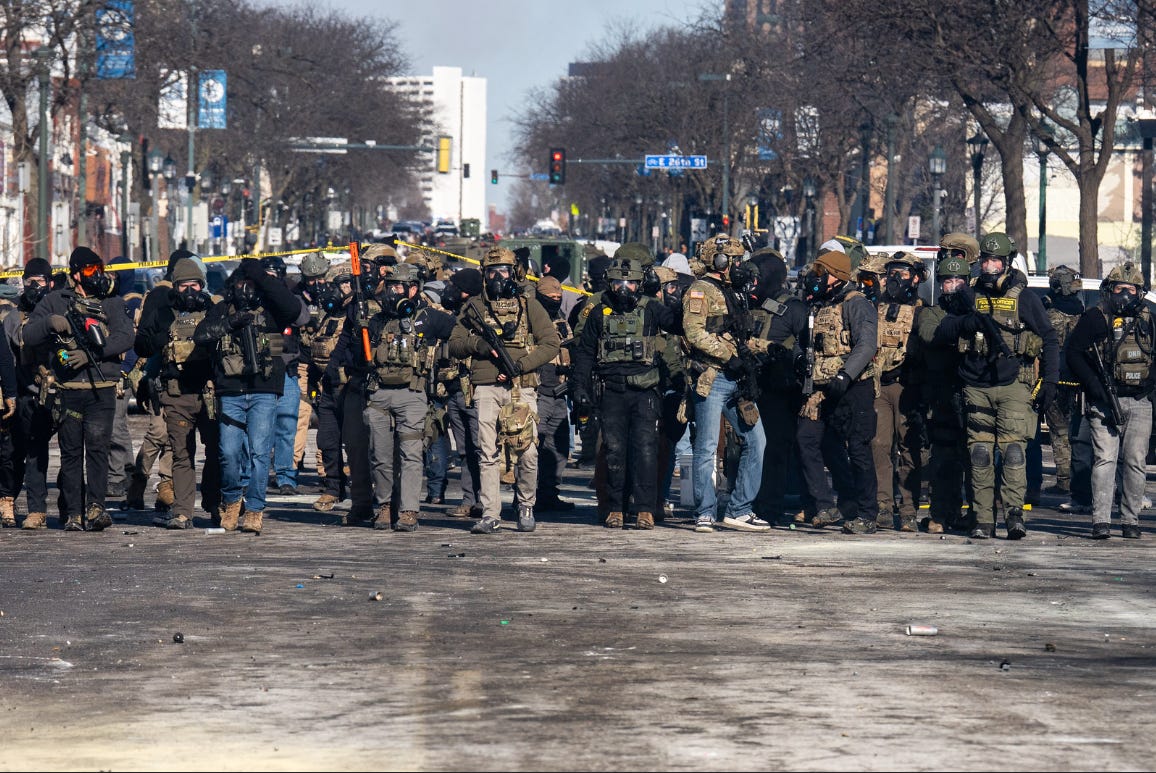
Leading image is a line of ICE and Border Patrol agents on Nicollet Avenue in Minneapolis on January 24, 2026. Credit: Chad Davis.
Insightful framework on why repression backfires. The observability factor esp makes sense given how social media amplifies these incidents way beyond what governments probablyexpected. Similar patterns played out during protests in my city where footage of overreach turned moderate folks into active oppponents. Underscores why tactics matter as much as policy goals.