
The Race for AI Depends on Accessing Land and Resources
That will get harder as the costs stack up

On his second day in office, President Trump gathered the CEOs of OpenAI, Oracle, and Softbank to publicly announce a partnership between the 3 companies to advance the development of AI in the US. The joint venture, known as Stargate, seeks to invest up to $500 billion in AI infrastructure within the next five years.
Now land and resources are at the center of the race to build out AI. At their core, programs like OpenAI’s ChatGPT require vast amounts of computing power. Creating that computing power means building massive, energy-intensive data centers. Last month, OpenAI put out a request for proposals for land, electricity, engineers, and architects in order to start building a network of large-scale data centers.
That search is going to be far more complex than it may seem. Around the country, companies like Amazon and Meta have been building data centers with large footprints. Many sites extend over more than 1,000 acres of land, encircled by razor wire fences. They marshal arrays of industrial fans and divert volumes of water in order to cool the computing equipment. Their noise and use of power and water have become a growing nuisance to communities that live near them even as they hold out the promise of creating new jobs locally.
ChatGPT requires the equivalent of a 16-ounce bottle of water when you ask it between 5 and 50 questions (depending on where the servers are located and the season). Given that, it’s no surprise that OpenAI launched its data-intensive GPT-4 model in Des Moines, Iowa, where in addition to drawing engineering talent it could also suck volumes of water out of the Des Moines and Raccoon Rivers to cool its data centers.
The water and power usage demands of data centers have become flashpoints. A growing list of proposed data centers across the US are being nixed because of them, bringing down local politicians that back them. In one recent example in Uruguay, a proposed Google data center faced public protests as the country struggled with a drought so severe that officials started mixing in available salty water into public drinking water supplies.
Land use considerations are also generating pushback. A recent proposed data center in Genesee County, Alabama nestled between a wildlife area and the Tonawanda Seneca Nation sparked public outrage. As one resident of the Tonawanda Seneca Nation put it, "Everything we believe in is tied to the land, the land is it. There is no going backward because once the land is gone where do we all sit?" Other residents were concerned about species loss and water usage in the area.
Resources are another key to building AI. In addition to burning fossil fuels to power data centers, they also require an enormous quantity of copper for wiring as well as rare earth minerals for semiconductors. That is fueling a race to source, extract, and process metals and minerals from around the globe as new data centers are built.
There is a growing discussion about how to reduce the negative impacts of AI on land, wildlife, watersheds, and the broader environment. Ambitious AI expansion plans like Stargate’s seek to end-run these discussions by moving quickly and promising a better future. But for many communities that become the targets of new data centers, that future is uncertain. And as the impacts of data centers on the land, communities, and local resources become more widely known, building infrastructure for AI is going to be more complicated.
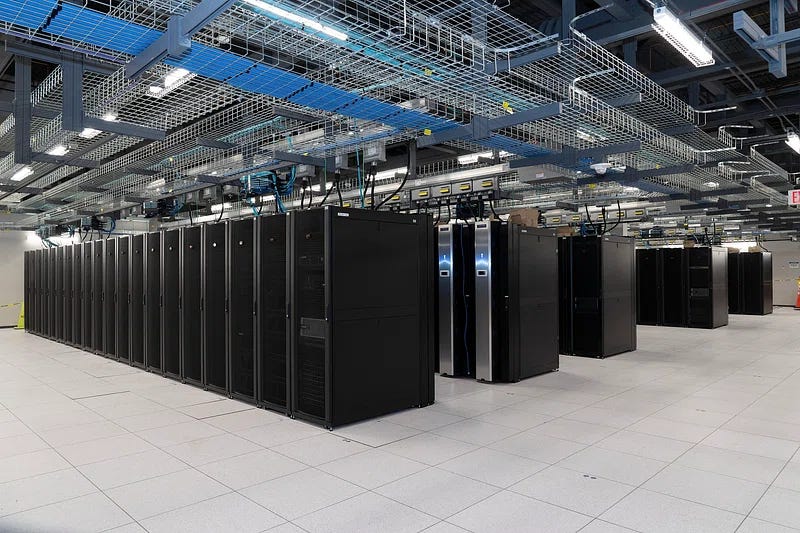
Leading image is a view inside a data center. The image is from the US Department of Energy via Rawpixel.