
What Happens Next in Iran and the Middle East
How the war could seed conflict and instability across the region and a power vacuum in Iran

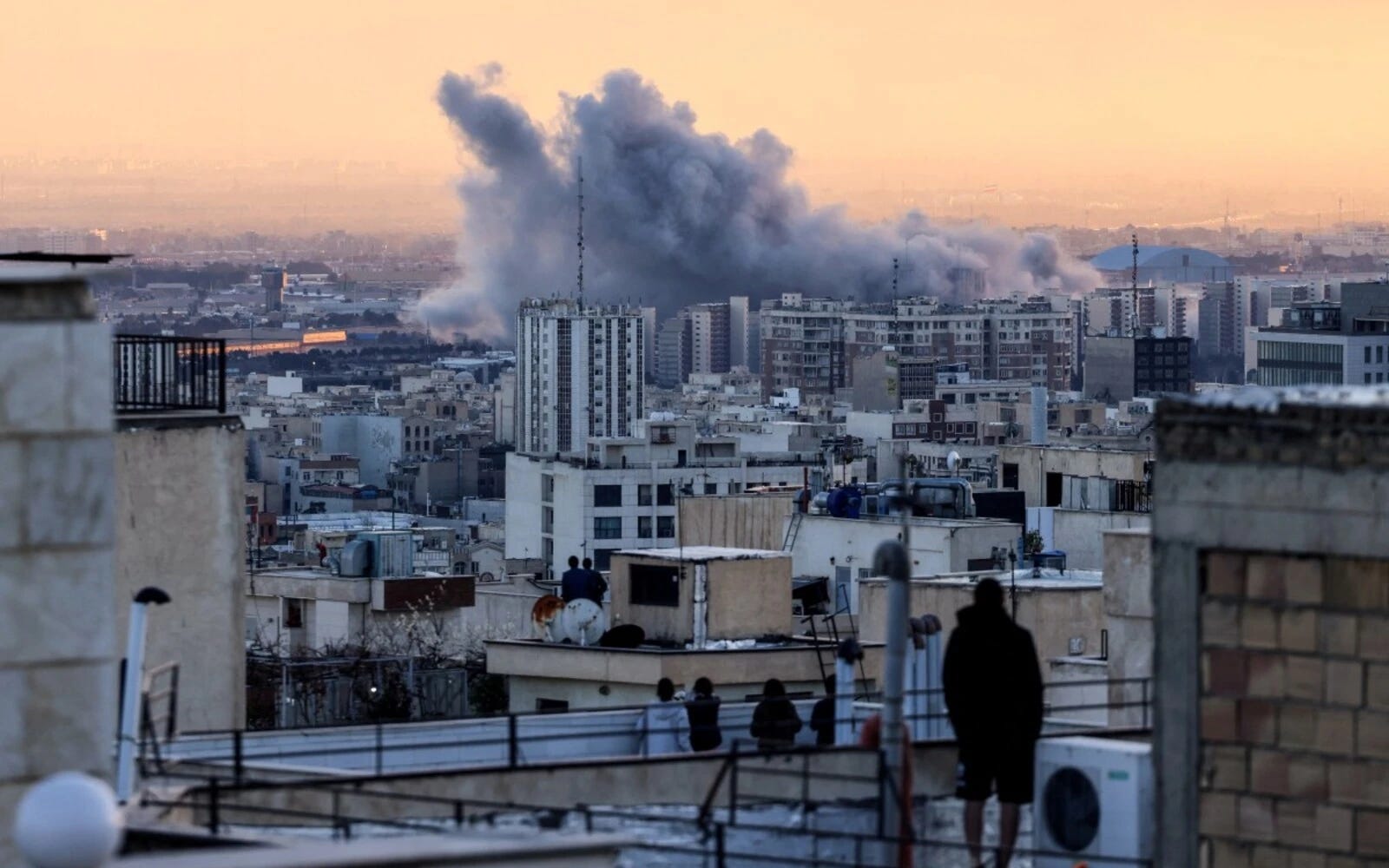
The war the US and Israel have launched on Iran is quickly becoming more chaotic and consequential as Iran’s leadership structure is being decimated and it lashes out across the region. In the last several days, Iran’s longtime Supreme Leader Ayatollah Khamanei and many top advisors and military commanders have been assassinated, the US and Israel have pounded Iran’s nuclear and ballistic missile sites as well as its navy, and Israel has advanced into southern Lebanon to confront Iran’s proxy ally Hezbollah. In response, Iran has unleashed a wave of retaliatory strikes, launching ballistic missiles and drones throughout the Middle East and closing the Strait of Hormuz, a critical international shipping lane through which 20% of the world’s oil passes.
The onset of the war was not especially surprising, shocking as events may be. As I wrote about in this post in January, the US, Israel, and Iran seemed poised for a head-on collision. Iran had been at its most vulnerable point in decades, and it was hard to see how the US and Iran could come to a mutually acceptable negotiated arrangement over its nuclear and ballistic missile capabilities. (That post also pointed to Cuba as another flashpoint; I expect that to come to a head in the next several months.)
Even so, the ferocity of the American and Israeli bombing and assassination campaign and the facts that there was essentially no public debate and discussion in advance and that Congress did not weigh in make the current conflict especially striking. Despite Trump’s longstanding pledges not to wage new wars in the Middle East and his attempts to cast himself as a peacemaker and dealmaker, here we are.
So what comes next? The Trump administration doesn’t appear to have an answer to that question, although it does have loose war aims. Meanwhile, Israel has its own priorities that extend beyond Iran.
Research on authoritarian regimes, civil war, and international relations all shed light on what could happen. So does recent history in the region.
One “Hot” War Will Lead into Others
After initially fumbling to explain its war aims, the Trump administration has now laid them out more clearly: eliminate all of Iran’s remaining nuclear program and capabilities, destroy its missile capabilities, destroy its navy, and stop it from funding proxies like Hezbollah and Hamas. To do all of this, Trump estimates “four to five weeks.”
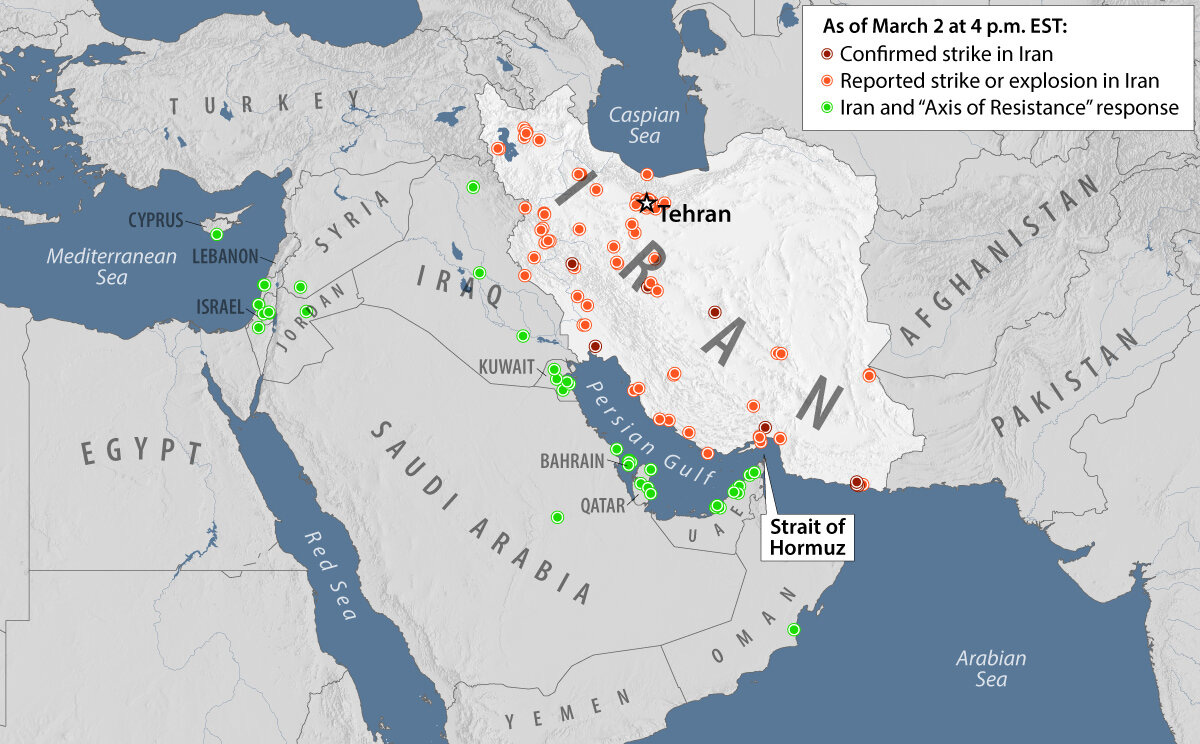
But research shows that wars aren’t turned on and off like a switch. Any end to the intense phase of the American and Israeli bombing campaign is likely to have periodic follow-ups. More importantly, the current campaign will have wide repercussions in a delicate region rife with institutional weakness and instability. Regional militias and movements from Hezbollah in Lebanon to the Houthis in Yemen and Shiite militias in Iraq are all implicated in the conflict and are gauging how to participate in their own local theaters. And while Iran’s Gulf neighbors are currently absorbing bombs and drones, they may come to strike back. A map of strikes in recent days shows hints of how the conflict could metastasize.
Meanwhile, Israel clearly doesn’t see the Iran conflict as addressing a single acute security threat. Since the Hamas attack on Israel in 2023, Israel has lashed out in Gaza, accelerated land grabs in the West Bank, attacked Hezbollah in southern Lebanon, occupied buffer areas in Syria, and supported the prior US bombing campaign against Iran’s main nuclear sites. Prime Minister Benjamin Netanyahu sees all of this as connected, and his successes have emboldened him to push even harder. That could tip fragile Lebanon into civil war, challenge peace initiatives in Gaza and the West Bank, and destabilize Syria.
Faced with an existential threat, Iran also has incentives to try to increase pain on the US and its allies in the region through and beyond any potential end of an American bombing campaign. If the regime manages to survive – more on that below – the ongoing events will only deepen its enmities against the West and its resolve to exact revenge. Here it is important to note Iran’s longtime specialization in asymmetric warfare. While it has considerable conventional military capabilities (that are being rapidly degraded), its unique role in the Middle East and beyond is underpinned by its support of proxy militias and terrorist cells. Those are far harder to disrupt from the air with a bombing campaign. Instead, they require on-the-ground intelligence. Current events are going to encourage the Iranian regime to double down on this strategy if it survives, raising risks for conflict that extend out years rather than weeks. And even if Iran’s regime falls, radicalized Shiites elsewhere may engage in the same. After all, Ayatollah Khamenei is a powerful religious figure and a symbol of defiance to the US and Israel; his assassination strikes many as not only deeply offensive but also heretical.
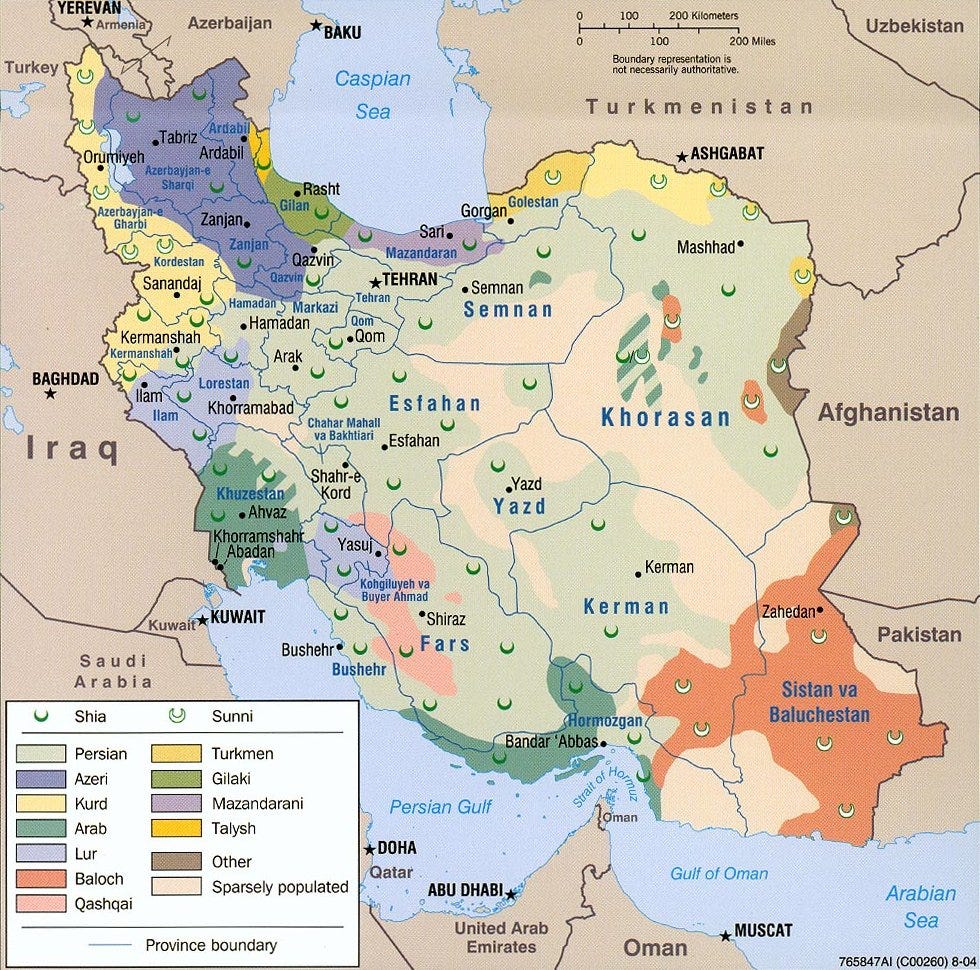
To the extent that the Iranian government is sufficiently weakened or entirely falls apart, there is also the very real specter of civil war and separatism. Iran is home to numerous ethnic minorities, many of them regionalized in peripheral areas that border neighboring countries (see map). Kurdish populations near Iraq and Baluchi populations near Pakistan may react to a power vacuum by trying to enhance their autonomies or make a bid for separation from Iran. That would in turn not only generate civil war but also implicate military responses from neighboring Iraq and Pakistan.
Regime Change in Iran
Beyond President Trump’s military war aims in Iran, he has also encouraged the Iranian people to seize their government. “The hour of your freedom is at hand,” Trump declared as the US and Israel unleashed its initial attack on the country. “When we are finished, take over your government. It will be yours to take. This will probably be your only chance for generations.”
Clearly, Trump would also be happy with regime change in Iran. Here again, research and an even cursory glance at recent history suggests this is far easier said than done.
There is no question that there was widespread opposition to the Iranian government. Nationwide protests during the Woman, Life, Freedom movement in 2022 and again more recently show the depths of discontent with the oppression and mismanagement of the Iranian government.
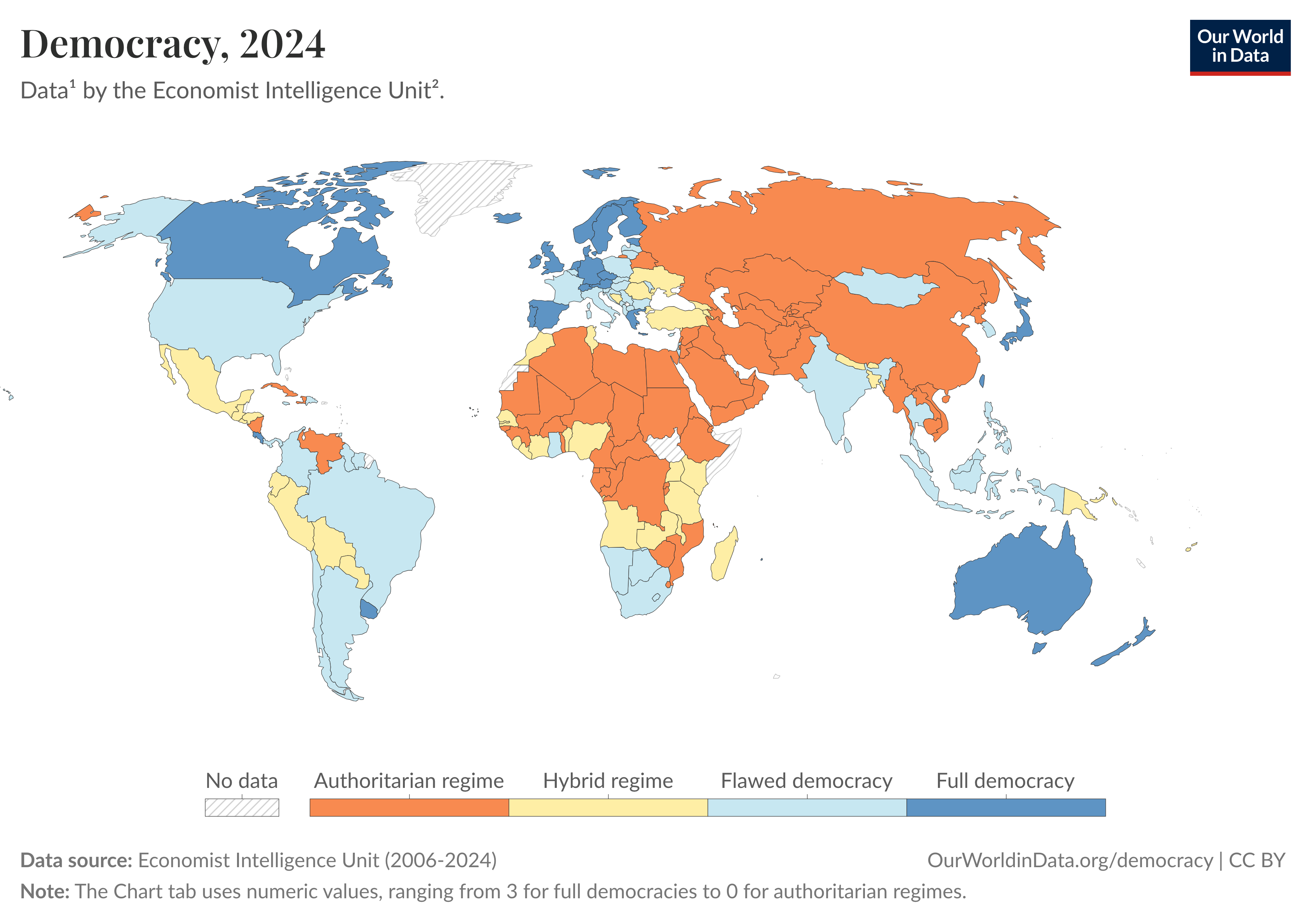
But opposition to one authoritarian government does not ensure a smooth transition to a better form of government. The Arab Spring uprisings, hopeful as they initially were, ended in failures to eliminate authoritarianism across the board. In Egypt it gave way to more repressive government; in Libya it paved the way to civil war; in Syria it sparked a brutal civil war and then a power vacuum; in Tunisia it resulted in a return to dictatorship. Interventions in Iraq and Afghanistan do not have an enviable track record either. Both became bloody fights that lasted well over a decade and gave way to instability and weak government. The Middle East remains hard ground for democracy (see map).
Iran is a diverse country of over 90 million people. It is internally divided along many lines. Uniting against a common foe like the brutal Iranian regime is something completely different than building a unified vision for an entirely new government. Asymmetries of power, collective action problems, and tricky distributional questions are rife.
Building a democracy – or even a new dictatorship – requires leadership, resources, and coordination. That is in increasingly short supply. When Trump was asked who he would like to see in power, his response was very revealing: “Most of the people we had in mind are dead,” he said. “Now we have another group, they may be dead also, based on reports. So you have a third wave coming. Pretty soon we’re not going to know anybody.” That sounds to me like it would tip more in the direction of civil war than democracy.
It’s also possible that the Iranian regime could survive the current attack, albeit in a far weaker condition that differs from what it was like under Khamenei. After all, it is a longstanding regime with fairly strong institutions that fuse together theocrats with a strong military and bureaucratic apparatus. Those who have invested in the regime and hold power would be likely fearful of the consequences of entirely giving that up and fight against it. And with a longtime monopoly on the use of force, many would need some credible opportunity for protection under an alternative arrangement. That is hard to provide absent strong leadership and considerable popular backing, which is difficult to envision in the present moment.
All of this makes the current military intervention all the more dangerous and unpredictable. Although Iran is going to be far weaker militarily in a few weeks, regionalized conflict and internal strife could very well spread long beyond that.