
When Democracy Hollows Out
A conversation with Peruvian political scientist Alberto Vergara on the country's endless crisis and the dangers of powerless democracy

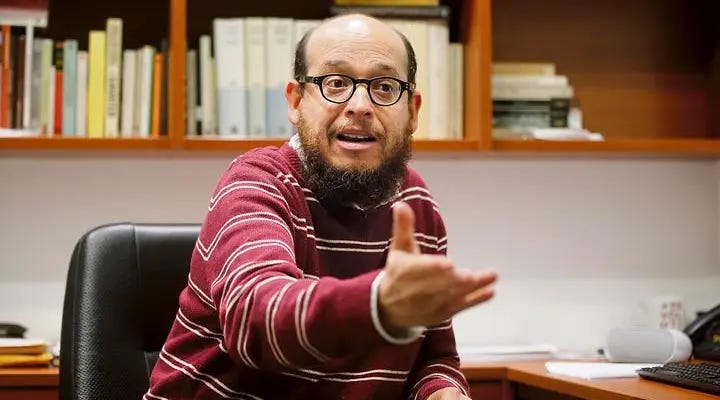
This post is an interview with Alberto Vergara, a political scientist at Universidad del Pacífico in Lima and one of the leading scholars of Peruvian politics and Latin American democracy. Alberto is the author of several books on political development and democratic instability in the region, including Democracy under Assault (2024), co-authored with Rodrigo Barrenechea, which develops the concept of democratic hollowing — a form of democratic erosion driven not by the concentration of power in the hands of a strongman, but by its opposite: the fragmentation and dilution of political representation to the point where democracy can no longer perform its basic functions. Peru, with eight presidents in ten years and 36 candidates in the first round of its presidential election that wraps up this Sunday, is the paradigmatic case. But as Alberto argues, it is far from the only one. With Peruvians heading to the polls this weekend to choose between far-left candidate Roberto Sánchez and right-wing Keiko Fujimori — daughter of the authoritarian president who governed Peru in the 1990s — I turned to Alberto to understand what is at stake, what democratic hollowing tells us about how this election is likely to unfold, and what, if anything, can be done to pull a democracy back from the brink once it has reached this point. For those interested in Peruvian politics or Latin American history, I also recommend his recent book, Modern Peru: A New History (2025), which offers a sweeping account of the country’s radical transition from an agrarian society to an upper-middle class export-based economy against a backdrop of repetitive political instability.
1) What is democratic hollowing, and how does it relate to the stability or quality of democracy?
Along with Rodrigo Barrenechea, I published “Peru: The Danger of Powerless Democracy,” proposing that democracy not only erodes through the well-documented path of concentration of power but also through the less known one of power dilution. The hollowing out of democracy means that parties and political elites are unable to aggregate interests and represent a society. Political representation becomes characterized by high fragmentation: the presence of countless amateur politicians that, in addition, circulate at high speed through the political system. This sort of political representation gives incentives for short-term behavior that erodes a democracy, making it increasingly unable to perform its minimal duties.
2) How has democratic hollowing been taking place in Peru in recent years?
Peru’s endless crisis with eight presidents in 10 years relates to this gradual process of representation decay. A conglomerate of amateur politicians has been unable to control a political process that goes from crisis to crisis without any of the actors being able to truly structure it. These actors all make short-term decisions while seeking to satisfy their most immediate personal interests, which turns Peru into a sort of prisoner’s dilemma on steroids. In the last three years there have been three presidents: none of them planned to become president. In Peru, it has become common to see politicians whose first job in politics turns out to be the presidency. Thus, fragmented, amateur, and constantly renewed actors fail to make democracy work.
3) Your work identifies three markers of democratic hollowing: electoral fragmentation, personalistic amateurism, and the absence of political linkages. Is there a sequence to these, and does one tend to drive the others, or do they operate separately? And is democratic hollowing a downstream consequence of prior political events (like prior political power concentration)?
We do not have a sequential theory. In the Peruvian case, the absence of linkages between parties and society has been a central element of political life for at least three decades. That is, without a doubt, the clearest mark of the absence of parties. In the absence of parties and structures where politicians can build effective political careers, politics has gradually filled up with free agents and transient figures. Fragmentation was the next step. And this process has not stopped. In the first round of this year’s presidential elections there were 36 candidates, and the combined vote share of those who advanced to the second round does not reach 30% of the votes cast. In other words, the dynamics of recent years have only deepened in these elections.
4) Do you think that we already see – or can envision – democratic hollowing starting to operate in other countries in the region or elsewhere? What makes a country more or less susceptible to this form of democratic erosion?
In the paper and in a subsequent book (Democracy under Assault, 2024) we propose that Peru is not a unique case suffering from hollowing. Countries such as Guatemala or Ecuador have a political class that is fragmented and dominated by very short-term interests. Noboa was elected president in Ecuador in a totally unexpected manner, and so was Bernardo Arévalo in Guatemala. And yet, both have faced great difficulties governing. In Chile, the number of mayoralties held by independents has increased significantly in recent years, as has the number of groups in the chamber of deputies. So this is not an exclusively Peruvian phenomenon.
5) Is there a pathway out of democratic hollowing, or is it self-reinforcing in ways that make recovery extremely difficult? Can you point to examples of other countries that have successfully rebuilt accountable and robust party systems after reaching the degree of hollowing as in Peru?
It is definitely very difficult to rebuild a party system once it has collapsed. In some countries, the collapse of the party system was followed by the re-articulation of a hegemonic party or movement, as in Bolivia and Ecuador with MAS and Alianza País, respectively. However, these days the Bolivian case illustrates well that once those parties decline, what remains is a fragmentation with no real reach into society, which enormously hampers the capacity to govern.
In any case, it is easier to identify countries in which a hegemonic vehicle emerges than to find the reappearance of a plural party system. MAS, Alianza País, and Morena in Mexico show that with the help of strong leadership, political vehicles can emerge. However, those very same vehicles tend to polarize their countries in a rather toxic way.
6) Peru has a very consequential election this weekend, pitting a far-left candidate (Roberto Sánchez) against a right-wing candidate (Keiko Fujimori) who is the daughter of Peru’s authoritarian leader from the 1990s. The last time a race like this played out a few years ago, it ended in a self-coup attempt by the leftist president and violence. What is at stake in this election, and how do you think it will impact Peru’s trajectory of democratic hollowing?
My sense is that this election will not be a breaking point in the trajectory of instability driven by democratic hollowing. Neither Keiko Fujimori nor Roberto Sánchez are in a position to stabilize a political system governed by the rules and practices of short-termism and self-interest. Keiko Fujimori believes she can impose order through repression and clientelism, but she will struggle to achieve the popularity and majorities that might allow her to stabilize her government. And Sánchez comes to power with a coalition of very weak individuals and parties. He himself failed to win a seat in the chamber of deputies.
The current elections contain and radicalize the presence of the main characteristics of democratic hollowing that have brought Peru to this point. It is difficult to suppose that the results could be any different from those obtained up to this day. In a hollowed-out democracy, chronic instability is far more likely than any form of tyranny.
Thanks for the explanation of the Peruvian situation! Lots of good context here.